
A customer's security team sends over a Common Vulnerabilities and Exposures (CVE) from the latest Android Security Bulletin and asks when your devices will be patched. You forward it to your ODM. The answer comes back: ongoing software maintenance was never scoped into the contract, so it has to be quoted as new work. Nobody did anything wrong. The deal ended at production.
That's a common place for Android OEMs to land. ODM agreements are written to get a device into production. Ongoing ODM OTA updates, meaning security patches, bug fixes, and new builds months after launch, often aren't priced in at all. They show up as a vague "reasonable support" clause or as per-job engineering quotes.
The pressure to patch doesn't only come from customers. In the EU, it's the law. Since September 2026, the Cyber Resilience Act has required manufacturers to report actively exploited vulnerabilities and severe incidents. From December 11, 2027, they must also fix vulnerabilities through security updates for the product's support period. If you sell connected devices into the EU, "our ODM is looking into it" is no longer an answer.
The US has no single rule like it, but one sector already has a patching mandate. Since March 29, 2023, federal law has required makers of connected medical devices that go through FDA review to make updates and patches available on a regular cycle for known vulnerabilities, and as soon as possible for critical ones.
You don't need to renegotiate everything to fix this. You need to pull apart two jobs that are currently tangled together: building firmware and delivering it.
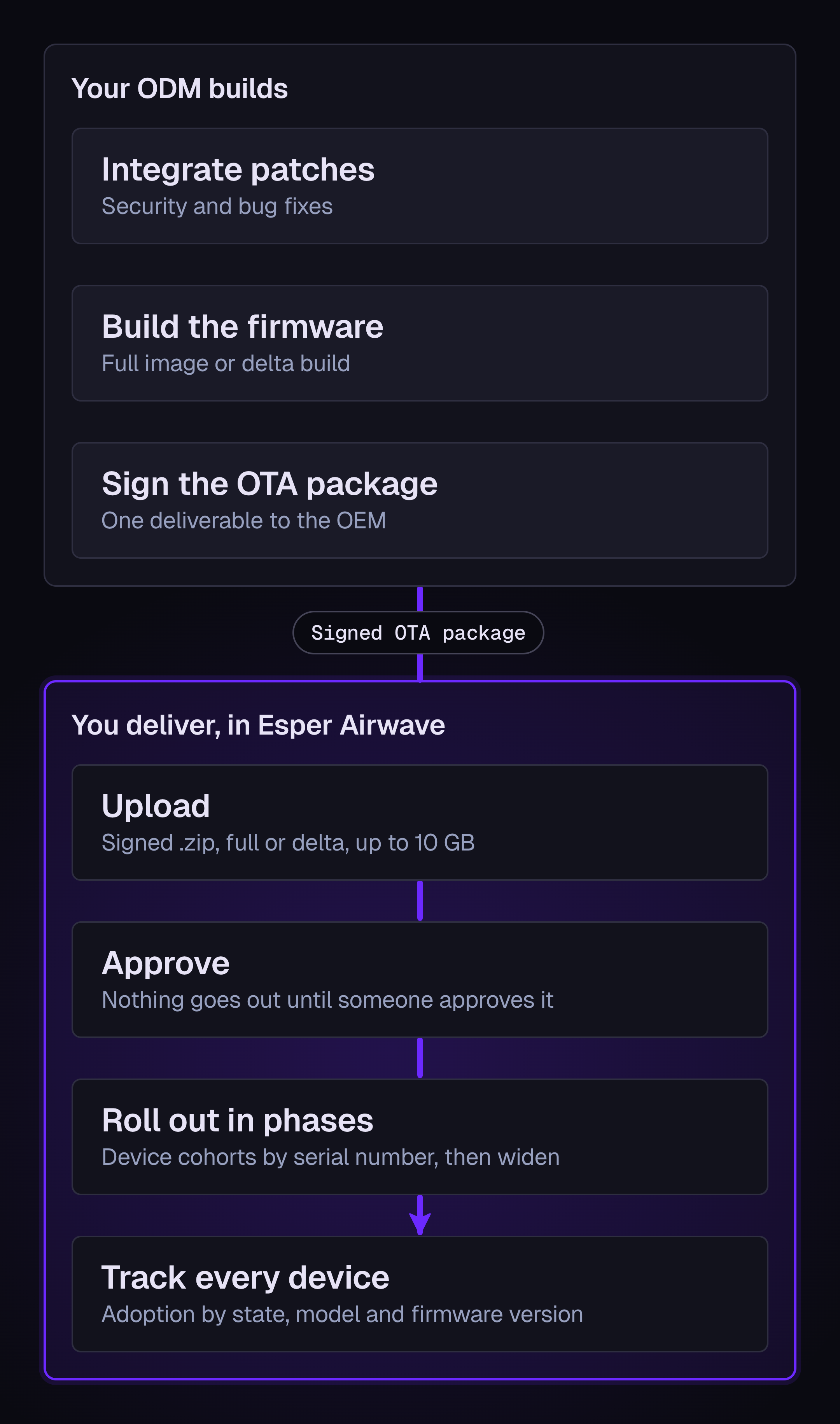
Your ODM builds the firmware. You own delivery.
Why ODM contracts stop at launch
An Original Design Manufacturer (ODM) designs and builds devices that another company sells under its own brand. For Android devices that usually covers chipset selection, board design, BSP and driver work, AOSP integration, the initial OS build, and manufacturing. It's a fast way to get to market without building a hardware and Android team.
The trade-off shows up after launch. If your ODM holds the source, the build environment, and the engineers who know your board, every software change goes through them. That includes the security patch your biggest customer asked about this morning.
Why updates fall out of scope
ODM deals are project-shaped: design fees, non-recurring engineering (NRE), a per-unit manufacturing price, acceptance testing, done. Lifecycle software support is open-ended, and it's hard to price into a fixed-scope project. So it gets left out, or gets written so loosely that nobody can enforce it.
Watch for language like this in your current agreement:
- "ODM will provide reasonable technical support during the product lifecycle." Reasonable by whose standard, at what response time, at what cost?
- "Bug fixes included for 90 days after production." A vulnerability disclosed in month seven isn't covered.
- "Software modifications quoted separately." Every patch becomes a new negotiation.
- "ODM retains ownership of software and tooling." You may not be able to build or modify your own device's OS without them.
What it costs you when updates stall
The direct cost is per-job engineering fees you never budgeted for. The bigger cost is time. Once a project ships, an ODM's engineers move to the next one, as the contract assumed they would. Bringing them back means new scoping, a refreshed build environment, and a slot in the schedule. Meanwhile your customer's patch window closes, and the audit or the RFP that asks for your update process doesn't wait.
Your options when the contract falls short
You have five realistic paths. They aren't mutually exclusive, and most OEMs end up combining two of them.
The pattern across all five: whoever controls delivery controls the customer experience. Even when your ODM keeps building the firmware, you can own when, where, and how it lands.
How Esper Airwave separates building from delivering
Esper Airwave is a standalone, MDM-agnostic OTA platform for Android OEMs and dedicated-device makers. Your ODM, or your own team, builds and signs the firmware. Airwave handles approval, targeting, phased rollout, and per-device visibility across the fleet, with no MDM required.
That split changes the ODM conversation. You're no longer asking them to run update infrastructure. You're asking for one deliverable: a signed OTA package.
We think it's a better deal for the ODM too. Building and signing firmware is their work. Running update infrastructure for every customer's fleet usually isn't.
How OEMs deploy an ODM-built update with Esper Airwave
The workflow in Esper Airwave has five steps:
- Register devices by hardware model and serial number. The Esper Airwave Agent runs on each device, and the OEM can preinstall it.
- Upload the firmware as a .zip (up to 10 GB). Esper Airwave extracts the metadata and supports both full images and delta builds from a specific previous build.
- Choose recipients: all compatible devices, or specific devices from a CSV of serial numbers (up to 10,000 per CSV).
- Approve the firmware. Nothing goes out until someone approves it. Approved firmware is offered only to compatible devices in the selected rollout.
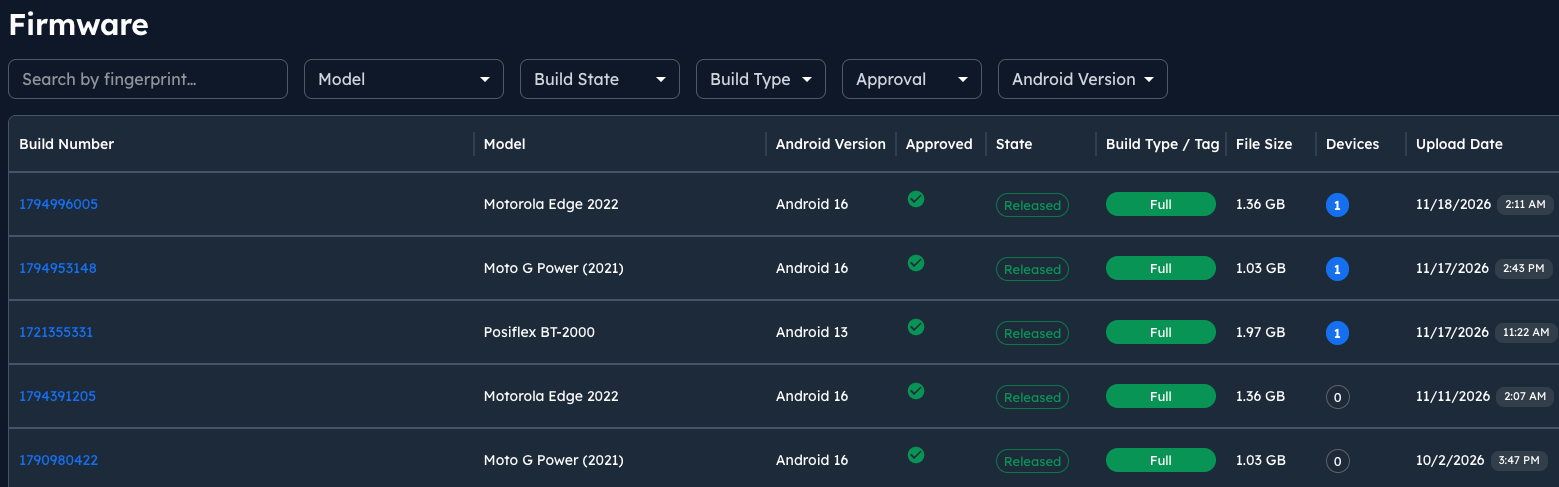
- Monitor adoption on the dashboard, by device state, by model, and by firmware version, down to the individual device.
Devices pull approved firmware at their next check-in. Nobody needs to touch a device in the field.
Phased rollouts on your schedule
Start with a small cohort: a pilot site, a test rack, the devices your support team can reach quickly. Watch adoption. Then upload more device lists (CSV) to widen the rollout, remove a list to stop the update from reaching those devices, or switch to all compatible devices once you're confident. The timing is yours.
What happens when an update fails
On A/B-partition devices, Android itself reverts a failed update to the previous slot at the bootloader level. Airwave shows you which devices took the build, which failed, and which rolled back, so you know where to look before you widen the rollout.
One delivery layer across ODMs
Because Airwave works with packages rather than with a specific ODM's tooling, the same console can serve every hardware model you register. If you add a second ODM, or move builds in-house for your next generation, your delivery process and fleet history stay where they are. Esper Product Manager, Kaylee Smith, says:
An ODM can hand you a signed package. What it usually can't hand you is control over what happens next. With Airwave, the OEM approves the build, decides which devices get it first, and sees what every device is running. That's the part worth owning.
Contract terms to ask for next time
For your current ODM, start with four questions:
- What OTA update support does our existing agreement include?
- What is your process and typical timeline from a security bulletin to a delivered OTA package?
- What does a single update cost if we need one outside the contract?
- Can you deliver signed OTA packages that we deploy through our own platform?
For your next ODM agreement, write the lifecycle in from day one:
- Update obligations: security update packages delivered within a defined number of days of bulletin publication, plus defined windows for bug fixes and emergency patches.
- Package format: signed full and delta OTA packages, delivered in a format your OTA platform accepts.
- Source and tooling access: a license to the source and build environment, build documentation, and the right to build packages yourself if the ODM misses its SLAs.
- Pricing: routine security updates covered by a predictable retainer, not per-incident quotes. Feature work quoted separately.
- Transition rights: the right to move software in-house with notice, plus defined transition help from the ODM.
Terms to clarify before you sign
Ask about any agreement that says:
- ...support ends 90 days after delivery
- ...every update needs a separate engineering quote
- ...the source stays proprietary to the ODM with no escrow or license
- ...update timing "depends on resource availability"
- ...only devices still in active production are supported
- ...OTA delivery runs only through the ODM's own proprietary system
Start where you are
You don't have to replace your ODM or hire an Android team this quarter to get updates under control. Ask your ODM for signed packages, and own delivery yourself. Your customers care whether their devices are patched. A clear split between who builds and who delivers is how you get there.
Frequently asked questions
Who is responsible for OTA updates, the OEM or the ODM?
The OEM is, in practice. Your brand is on the device, and customers and regulators come to you. Whether your ODM has to help depends entirely on the contract. Many ODM agreements cover design and production but leave post-launch software maintenance out of scope or bill it per job, so check your support and warranty clauses before you assume patches are covered.
How can an Android OEM ship security patches if the ODM won't run updates?
Split the work. Ask the ODM for one deliverable, a signed OTA package, and run delivery yourself on a managed OTA platform. With Esper Airwave, you upload the package, approve it, roll it out to device cohorts by serial number, and track adoption per device. Devices pull the update at their next check-in, with no field visits.
How is a managed OTA platform different from an MDM?
An MDM configures and manages devices: apps, policies, settings. A managed OTA platform delivers the firmware itself. Esper Airwave is standalone and MDM-agnostic, so you don't need Esper MDM or any MDM to use it. It focuses on firmware approval, phased rollout, and fleet-wide visibility into which build each device is running.
Does the EU Cyber Resilience Act affect Android device makers?
If you place connected products in the EU market, yes. Since September 2026, manufacturers must report actively exploited vulnerabilities and severe incidents. From December 11, 2027, broader obligations apply, including addressing vulnerabilities through security updates during the product's support period. Fines can reach €15 million or 2.5% of worldwide annual turnover. Check with counsel for your specific products.
How do I get started with Esper Airwave?
Esper Airwave is available to OEMs and other teams that need OTA updates, and access is by request. You can start with a 50-device test cohort. Pricing is customized to your scope, so the fastest path is to talk to an Airwave engineer about your current ODM setup and the devices you need to reach.
Talk to an Airwave engineer
Bring your ODM setup and your fleet. We'll show you how to run OTA delivery yourself, starting with a 50-device test cohort.
Talk to an engineer → Book your demo