Stratacache sold Scala to Vertiseit — and the financial pressure that forced that sale didn't disappear with it. Whether you're running Scala or ActiVia, the device management capabilities embedded in your signage platform are now tied to a vendor in flux. Esper adds a dedicated device infrastructure layer underneath your existing platform — independent of Scala's new owner, independent of ActiVia's parent company, independent of anyone's roadmap but yours.
Your screens keep running. Your content workflows stay intact. You stop inheriting someone else's decisions.
A multi-brand restaurant operator running 23,000 devices across two casual-dining banners was generating 14,000 support cases per month. The problem wasn't headcount. Nothing about their configuration was wrong. Their device management tooling could tell them what had already broken — it couldn't tell them what was about to break.
After deploying Esper, the team identified 4,000+ preventable support cases per month by shifting from reactive ticketing to proactive telemetry. Esper flagged screens before they went dark during dinner service and corrected drifting devices before anyone needed to travel to the site. Same devices. Same content platform. Dedicated device infrastructure added underneath — scoped in weeks.

Esper is an indispensable tool for managing our devices. It allows us to effectively manage our devices both individually and as a cohesive unit. When deciding on hardware for our fleet, our first priority is ensuring it’s compatible with the Esper platform.


Esper is a true partner. Working with them allows us to move fast, save money, and now we can make strategic decisions about what hardware to use.


Scala and ActiVia both include device monitoring as part of their CMS feature sets. That's not the same as a device management infrastructure — and the gap between them is what creates operational risk when a vendor is in flux.
Esper operates at the OS layer, below your CMS. It doesn't touch content scheduling, playlist management, or your content workflows. It manages the device running your content platform: OS updates, firmware management, boot behavior, network policy, and security posture. Your CMS keeps doing its job. Esper makes the device underneath it reliable at infrastructure scale — independent of whichever CMS vendor you're running, and independent of whatever that vendor does next.




Esper is OEM-independent and operates at the OS layer, not the hardware layer. Android signage screens from Samsung, LG, BrightSign, or any AOSP-compatible manufacturer work without a hardware swap. Your existing screens, mounts, and network infrastructure stay in place. The migration adds a dedicated device management layer — it doesn't replace anything at the hardware level.
Esper deploys alongside your existing infrastructure. You migrate location by location, region by region, at whatever pace your operations calendar allows. Your CMS — Scala, ActiVia, or otherwise — continues to schedule and distribute content exactly as it does today. Screens that move to Esper pick up their Blueprint and enforce device state immediately. No all-or-nothing cutover. No disruption to what your stores see on screen.
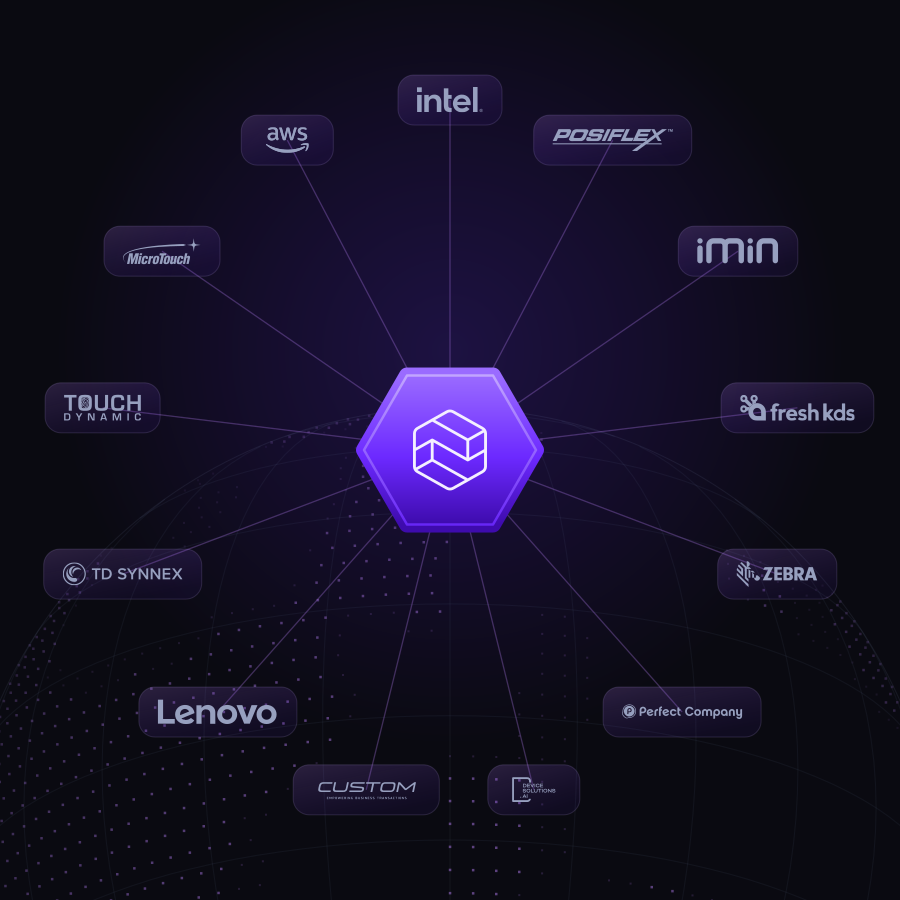
Migrations expose dependencies: content players tuned to a specific provisioning flow, hardware vendors whose support contracts reference a platform that no longer exists in its original form, CMS integrations built around a specific device management API. Esper's partner network spans content platforms, hardware manufacturers, and deployment services to bridge those gaps during transition.
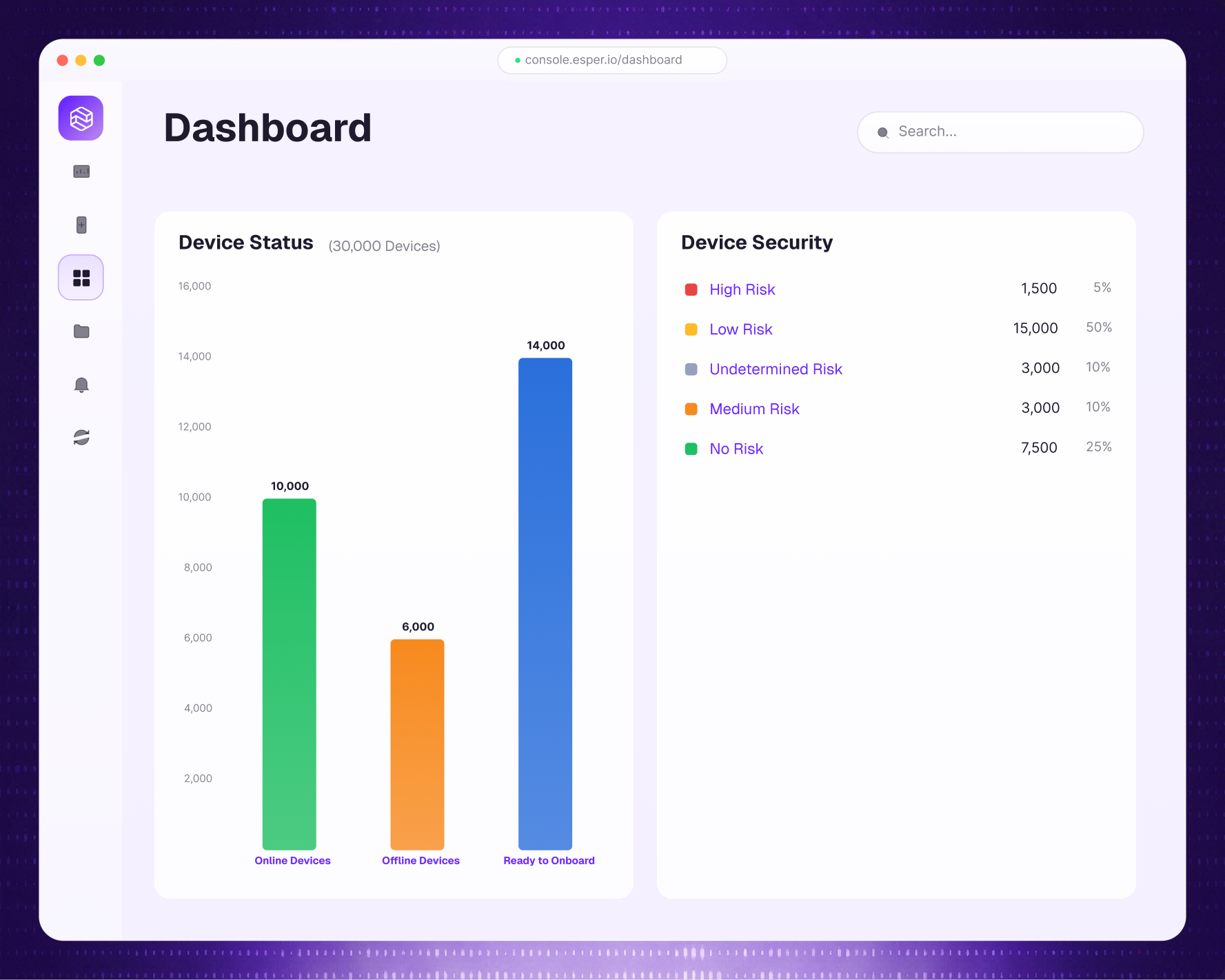

Blueprint-based configuration.
Define the desired state of any device group — apps, OS version, Wi-Fi, security policies. Every device in the group stays in compliance automatically. Configuration drift is corrected before it generates a support ticket.
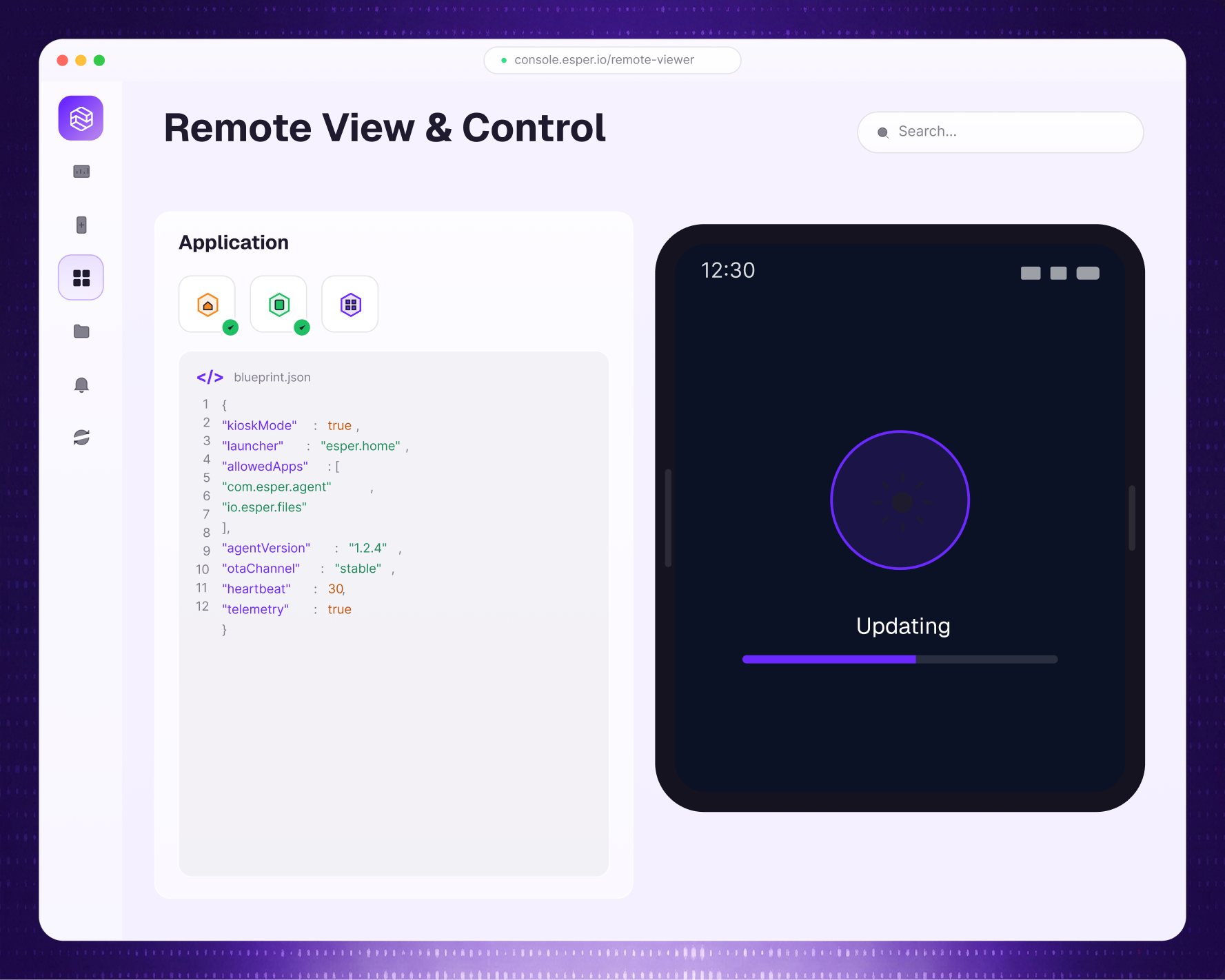
Staged OTA rollouts.
Test firmware or app updates on a subset of devices before pushing fleet-wide. Set rollback triggers. Push with confidence across 10 devices or 100,000.
Real-time fleet visibility.
Live connectivity status, device health, app version, and location data across every device in your fleet. All in one place.
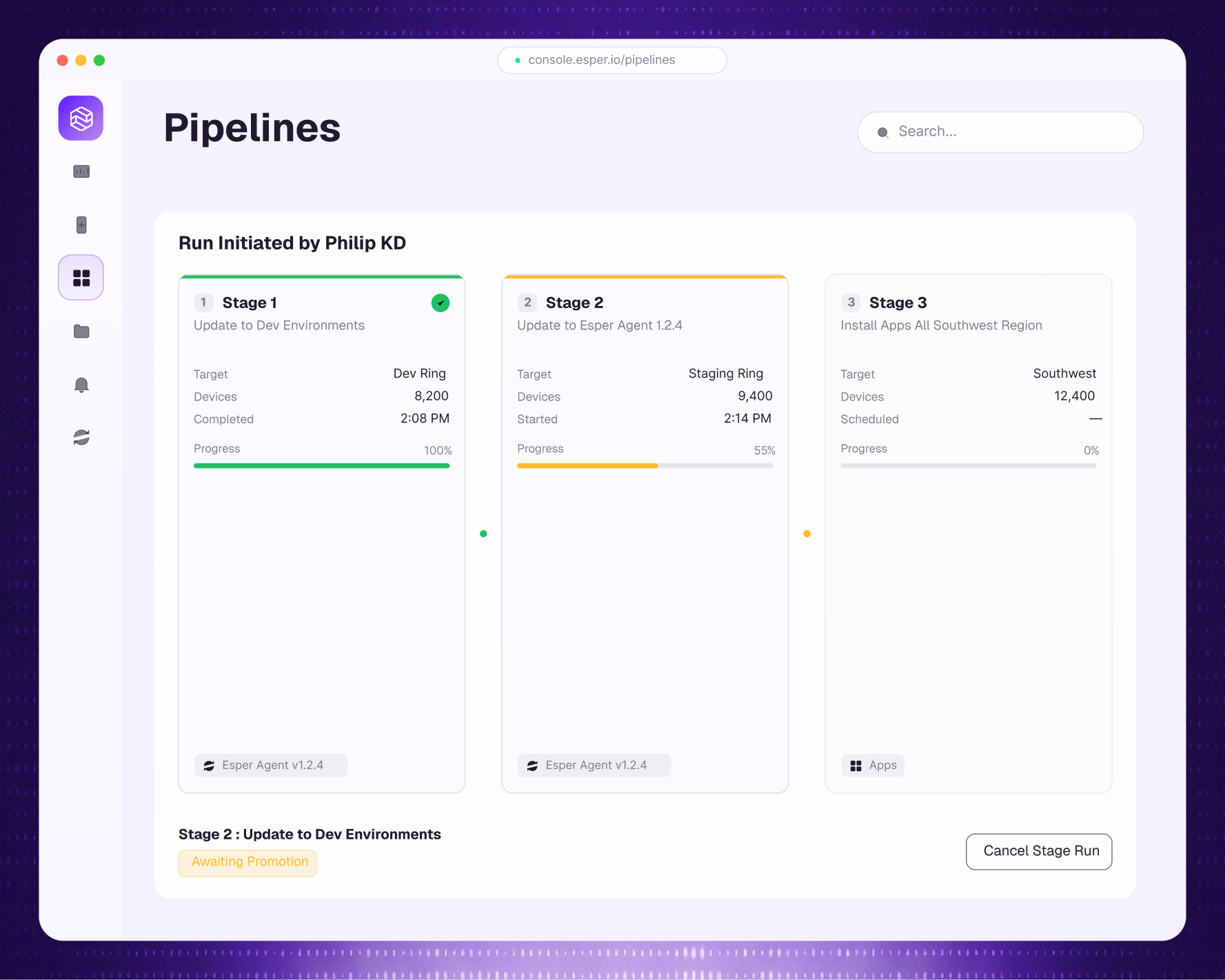
Zero-touch provisioning.
Devices come online pre-configured via QR code, NFC, or OEM provisioning program. No manual setup. No kitting delays. No technician required at the site.
Remote control and diagnostics.
Full remote access to any device, anywhere in your fleet. Run commands, pull logs, reboot, and resolve incidents without dispatching a technician.
Proactive device health monitoring.
Esper surfaces device health signals — connectivity degradation, storage pressure, app instability — before they generate a support ticket. Shift from reactive break-fix to proactive remediation.
Content integrity enforcement.
Only approved apps and content run on enrolled devices. Unauthorized changes are blocked at the OS level.
Kiosk mode lockdown.
Restrict devices to a single app or defined interface. Users can't access system settings, the file system, or any unauthorized functionality.
PCI DSS and SOC 2 Type 2 certified.
Esper meets the security standards required for enterprise retail and QSR deployments.
If your Stratacache infrastructure runs both signage displays and interactive kiosks — self-order, loyalty check-in, endless-aisle — you don't need two migration paths. Esper treats both form factors as dedicated hardware with a defined desired state. Your content layer differs between the two form factors; the device infrastructure layer is identical.



Yes. Esper is OEM-independent and operates at the OS layer. Android signage screens from Samsung, LG, BrightSign, and other AOSP-compatible manufacturers work without replacement. Your existing screens, mounts, and network infrastructure stay in place. Esper adds the device management layer — nothing at the hardware level changes.
Your CMS continues to operate exactly as it does today. Scala keeps scheduling and distributing content. ActiVia keeps doing the same. Esper manages the device underneath the content player — OS state, firmware, security posture, network configuration. The two layers are architecturally independent. That independence is precisely what makes this migration possible without disrupting store operations.
The Esper migration path is the same regardless of which Stratacache-family CMS you're running. Esper operates at the OS layer, below your CMS — it doesn't interact with content scheduling, playlist management, or the application layer of either platform. What differs is the urgency driver: Scala customers are navigating new ownership with a device-agnostic product direction; ActiVia customers are managing a parent company under financial pressure with an uncertain roadmap. Both point to the same architectural conclusion.
There's no all-or-nothing cutover. You migrate location by location or region by region at whatever pace your operations calendar allows. Screens continue running on the existing platform until your team transitions each one. Enterprise QSR fleets in the tens of thousands of devices have migrated in weeks using Esper's Blueprint model.
Esper treats signage and kiosks as the same device management problem: dedicated hardware with a defined desired state. You don't need separate migration paths. For kiosks running web-based applications, Esper Titanium provides browser-layer control purpose-built for dedicated hardware.
For kiosks using app pinning, simply swipe up and hold (you may also need to enter the PIN, pattern, password, or biometric authentication). For apps placed into kiosk mode using kiosk software, only an administrator can exit kiosk mode.Esper's console is built for operations teams running dedicated device fleets. The concepts your team already uses — device grouping, policy enforcement, remote access, provisioning workflows — map directly. Esper's deployment engineering team works alongside your team during migration to close any gaps.
GET STARTED
The window right now is the cleanest it will be. Contracts are in flux. Renewal leverage is highest before new ownership or a restructured organization resets the terms. Your team hasn't yet absorbed the operational cost of adapting to someone else's new product direction.
Esper adds dedicated device infrastructure underneath your existing signage fleet — independent of Scala's new ownership, independent of ActiVia's parent company, independent of any CMS vendor's roadmap. Your hardware stays. Your content keeps running. Your fleet comes under your control.